
THE SCIENCE BEHIND NATURAL SALIVA PRODUCTION
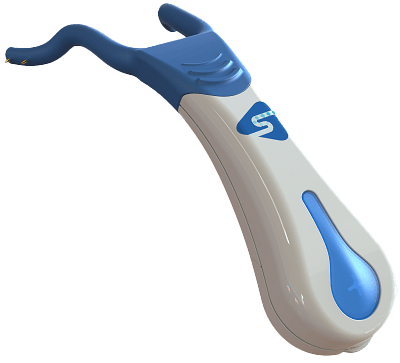
SaliPen is an FDA-cleared medical device for the relief of dry mouth. The studies
summarized in this document show how gentle intraoral electrostimulation can help
increase the body’s natural saliva production.
Why saliva matters
Saliva does far more than make the mouth feel wet. It helps us speak clearly, taste our food, chew easily and swallow safely. It also helps protect our teeth and oral tissues. When too little saliva is produced, everyday activities can become uncomfortable and oral health may suffer.
Dry mouth may occur with aging, medicines, autoimmune conditions, diabetes, cancer treatment and other health problems.
Many products to treat dry mouth provide only temporary moisture or induce adverse side-effects. SaliPen takes an innovative approach: it is designed to safely stimulate the body’s own saliva reflex.

How the natural saliva reflex works
The lining of the mouth contains sensory nerves that respond to touch, taste, movement and mild electrical signals. When these nerves are activated, they send messages through the nervous system. The salivary glands are then triggered to respond by releasing saliva.
Where SaliPen fits
SaliPen is a small intraoral medical device. Its flexible arms are positioned along the lower gums. During use, the device delivers gentle, low-intensity electrical stimulation to activate the salivary glands to produce natural saliva.
SaliPen is an FDA-cleared medical device for dry mouth relief. It is an over-the-counter device, meaning you do not need a medical prescription to buy it.
It is drug-free, reusable, and intended for regular home use for a few minutes each day, according to the instructions.
Why SaliPen is different from other moisture products
- It is designed to activate the natural saliva reflex rather than simply coat the mouth.
- It is drug-free and acts locally inside the mouth.
- Its clinical rationale is supported by published studies of intraoral electrostimulation.
- It can be used as part of an ongoing dry-mouth management routine, following the instructions for use.
What researchers measured
Clinical studies looked at both how people felt and how their mouths functioned. Outcomes included the severity and frequency of dryness, oral discomfort, speaking, swallowing, sleep interruption, and saliva production.
Rapid and cumulative improvement
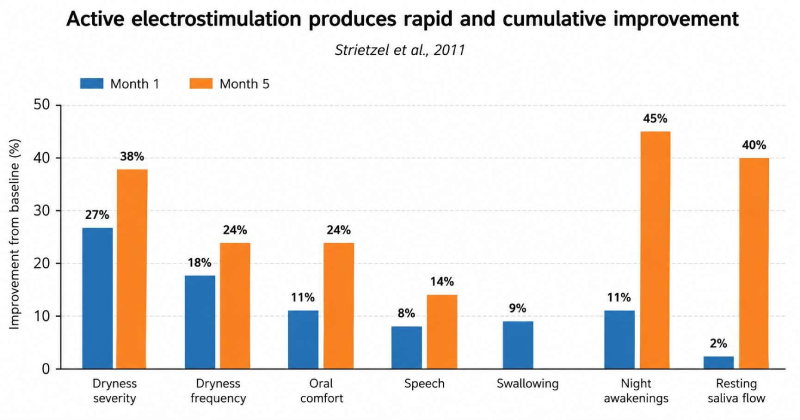
In a large multicenter randomized study by Strietzel and colleagues, people using active intraoral electrostimulation reported improvement after the first month and further with continued use through five months.
Dryness severity diminished by 27% after one month and by 38% at five months. The frequency of dry mouth episodes decreased by 18% and then 24%. Oral comfort improved by 11% and then 24%. Night awakenings were reduced by 11% initially and by 45% at five months. Resting saliva flow showed little change after one month but increased substantially with continued use, reaching about 40% above baseline after five months.
What this means
The study suggests that benefit may begin within the first month and may build with regular use.
Benefits sustained for nearly a year
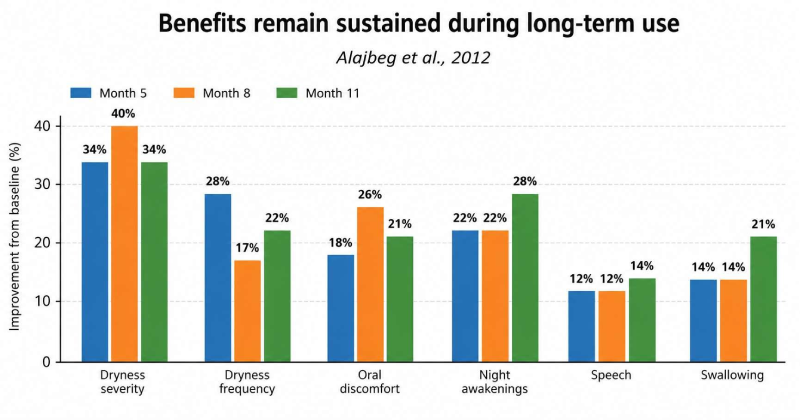
In a long-term multicenter follow-up study, Alajbeg and colleagues observed people using intraoral
electrostimulation for up to 11 months. Improvements remained present across the follow-up period.
- Perceived oral dryness severity improved by 34% at month 5, reached 40% at month 8 and remained 34% better at month 11. Improvements were also maintained in dryness frequency, oral discomfort, speech, swallowing and night awakenings.
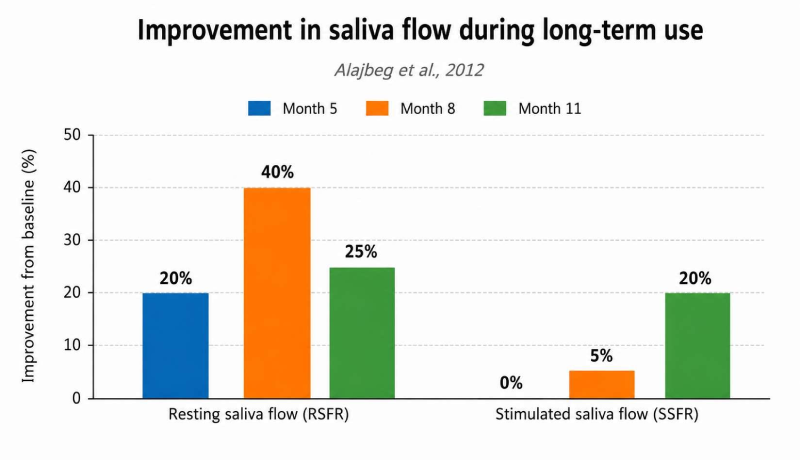
- In addition, saliva production increased over time. Improvements were observed in both unstimulated (resting) salivary flow and stimulated salivary flow measured while chewing
What this means
The results support the existence of sustained benefit during continued use.
A closer look at people with extremely low saliva
The long-term study also reported a small subgroup of eight participants who began with no measurable saliva at all. During follow-up, seven of them started producing measurable saliva.
What this means
This finding is encouraging, but it should not be interpreted as a guarantee that salivary function will be completely cured in every person with very severe gland damage.
Improvement over 12 weeks
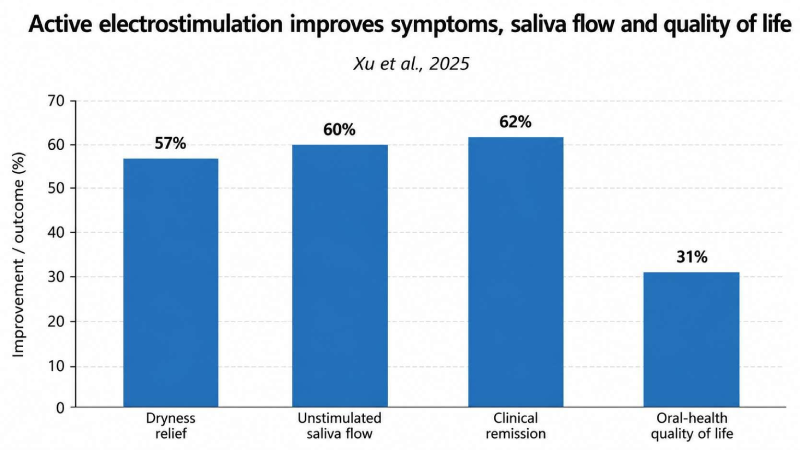
In a later randomized controlled trial, Xu and colleagues studied intraoral electrostimulation over 12 weeks. Dryness severity improved by 57%, saliva production increased by 60%, and 62% of participants met the study’s definition of clinical remission at Week 12. Negative effects of oral health on quality of life improved by 31%.
What this means
The study found that electrostimulation was associated not only with symptom relief, but also with a measurable increase in saliva flow and improvement in day-to-day oral well-being
Putting the evidence into perspective
Taken together, the studies show a consistent pattern: intraoral electrostimulation can improve symptoms of dry mouth and increase natural saliva production. Benefits were seen over periods ranging from several weeks to almost one year.
References
- Strietzel FP, et al. Efficacy and safety of an intraoral electrostimulation device for xerostomia relief: a
multicenter, randomized trial. Arthritis & Rheumatism. 2011;63:180-190. - Alajbeg I, et al. Intraoral electrostimulator for xerostomia relief: a long-term, multicenter, open-label,
uncontrolled clinical trial. Oral Surgery, Oral Medicine, Oral Pathology and Oral Radiology.
2012;113:773-781. - Xu Y, et al. Effect of electrical stimulation of lingual nerve on xerostomia: a randomized controlled
trial. JDR Clinical & Translational Research. 2025;10:282-293.
Medical information notice
This information is intended for general education and does not replace professional medical or dental advice. SaliPen should be used according to the instructions for use. Individual results may vary.